
To be honest, I hadn’t even planned on playing Final Fantasy Tactics: The Ivalice Chronicles. Like many others, I got hooked by the hype. First, it was the English-speaking YouTube scene with video essays hailing it as having the “best story in the entire franchise.” Then came the “Best Sim/Strategy Game” award at The Game Awards 2025—won by a game that was originally released thirty years ago. And then I remembered that the character designer was Akihiko Yoshida, the very same artist who created 2B from NieR: Automata.
By the time the remaster was announced, I already knew pretty much everything there was to know about Final Fantasy Tactics: Yasumi Matsuno, the War of the Lions, and the fact that it was actually the franchise’s first-ever spin-off. I simply wanted to take a trip back in time and see how well this artifact from a bygone era had held up. Spoiler alert: it has aged beautifully, though not without a few quirks. And yes, I had already sunk over 100 hours into the original game.
Final Fantasy Tactics isn’t just a tactical RPG; it is a genre-defining masterpiece. Released in 1997, it remains one of the deepest and most complex titles in gaming history. Created under the direction of Yasumi Matsuno, the game blends Game of Thrones-level political drama with one of the most flexible and intricate combat systems ever realized in a video game.
The Ivalice Chronicles remaster represents Square Enix’s attempt to revisit a classic in a more accessible format. The game was released on September 30, 2025, for PlayStation 4, PlayStation 5, Nintendo Switch, Switch 2, Xbox Series X|S, and PC.
So, the Kingdom of Ivalice. The Fifty Years’ War has ended in defeat; the country is in decline, knights go unpaid, and the peasantry is restless, while the king is a weak ruler plagued by ill health. The queen effectively holds the reins of power—a state of affairs that displeases many. It particularly irks a certain Council, which orchestrates an assassination attempt on the two princes to clear the path to the throne for Princess Ovelia—an adopted girl who is not a princess at all, but a double for the late king’s true daughter, groomed by the Council specifically to spite the reigning queen. However, the Council’s plans go awry: the queen unexpectedly gives birth to another son, and Ovelia is sent off to a monastery.
A year after the war, the king dies without having named an heir or a regent. A struggle for the regency ensues between two dukes: Goltana and Larg. The former is a relative of the late king and commands the Order of the Southern Sky (Zuiden); the latter is the queen’s own brother and commands the Order of the Northern Sky (Norden). This conflict goes down in history as the War of the Black and White Lions. The entire tale is recounted by a historian who, years later, is examining newly discovered church archives. The official history holds that the war’s greatest hero was Delita Hyral—a commoner who rose to become king. Yet, for a long time, the Church suppressed the name of the true hero: Ramza Beoulve, who was branded a heretic and erased from the historical record.
The story begins with a cutscene showing Delita Heiral and a band of mercenaries riding chocobos toward Orbonne Monastery to kidnap Princess Ovelia. While a skirmish, serving as a combat tutorial, breaks out in front of the monastery between Goltana’s men and the mercenaries guarding the princess, Delita carries out his plan. Among the mercenaries is our protagonist, Ramza; he spots Delita riding away and realizes that the two of them had once been friends.
The events of the first chapter take place a year before the War of the Lions. Ramza and Delita are cadets at the military academy in Gariland and members of the Order of the Northern Sky, commanded by Ramza’s family, House Beoulve. The events of the chapter lead to Delita realizing the vast social chasm between himself and Ramza’s family while Ramza renounces his family name, adopts his mother’s surname, and becomes a mercenary.
A year later, Ramza sees Delita again—alive and in the act of abducting the princess. He sets off in pursuit but it turns out that Duke Larg and Dycedarg had hired Gafgarion to kidnap and eliminate the princess—thereby disposing of an inconvenient heir and framing Goltana for the deed—but Delita beat them to it and exposed the plot. This is where this extraordinary story starts.
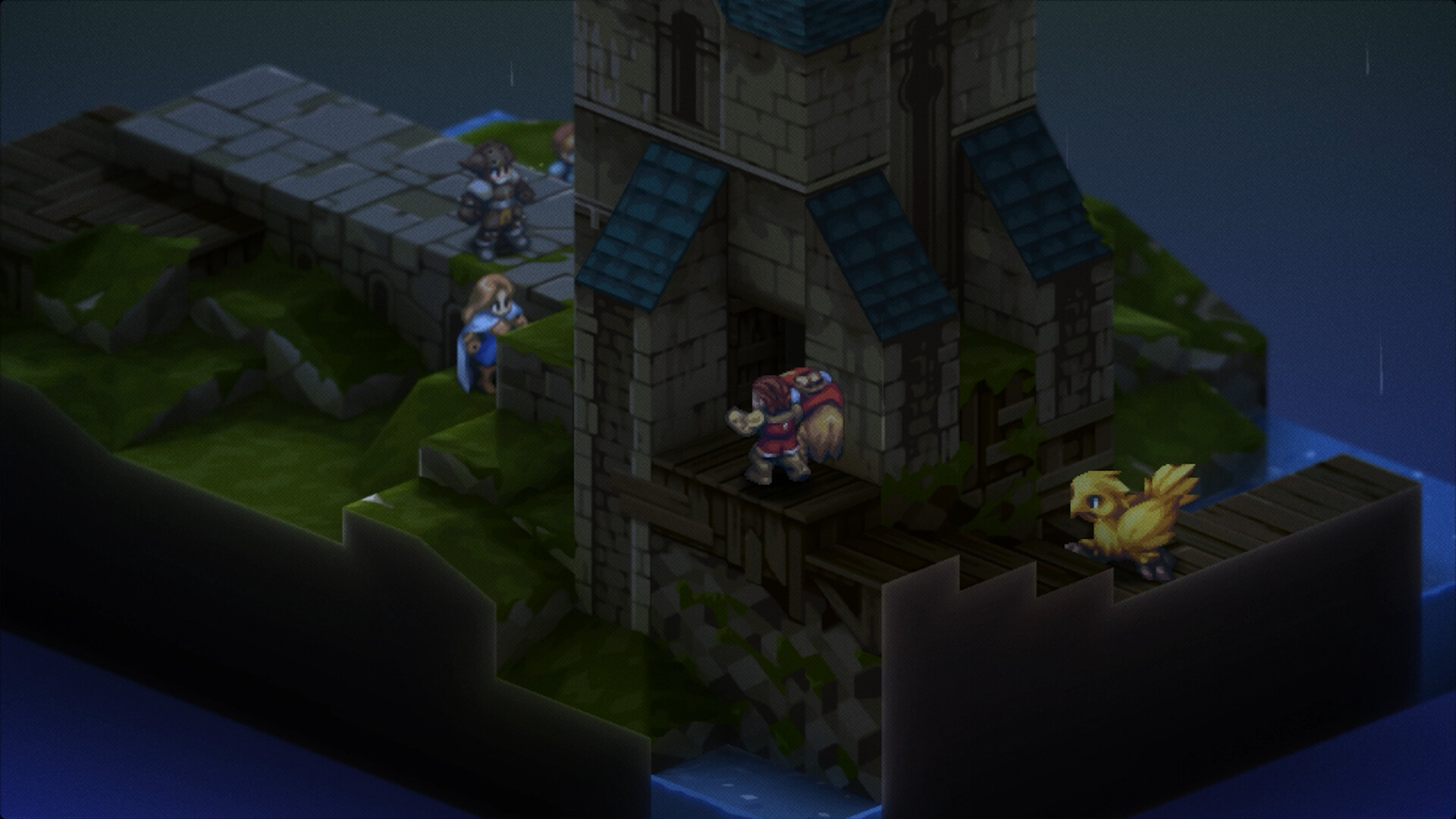
Final Fantasy Tactics is a classic tactical RPG that doesn’t forgive mistakes. Battles take place on schematic, rectangular maps divided into a grid of varying terrain. At the start of a battle, you deploy up to five units, including Ramza, whose participation is mandatory in story battles. Units take turns, performing a move (traversing several squares) followed by an action determined by their job class.
A unit can fall in battle; if they remain incapacitated for three of their turns, their body vanishes forever, leaving behind either a treasure chest or a crystal that restores health and mana. It is best to ensure no ally stays down for too long—and in Ramza’s case, doing so can even result in a game over.
Between battles, you must handle management tasks: buying gear, switching jobs, and unlocking abilities. This can feel a bit tedious at times. There are heaps of numbers involved, and it isn’t always clear what affects what. It seems like everything influences damage: the specific square, the terrain material, the angle of attack, the unit’s elevation, their gender, and even their zodiac sign. However, the game isn’t so difficult that you need to account for every single nuance, there is no need to waste time on min-maxing.
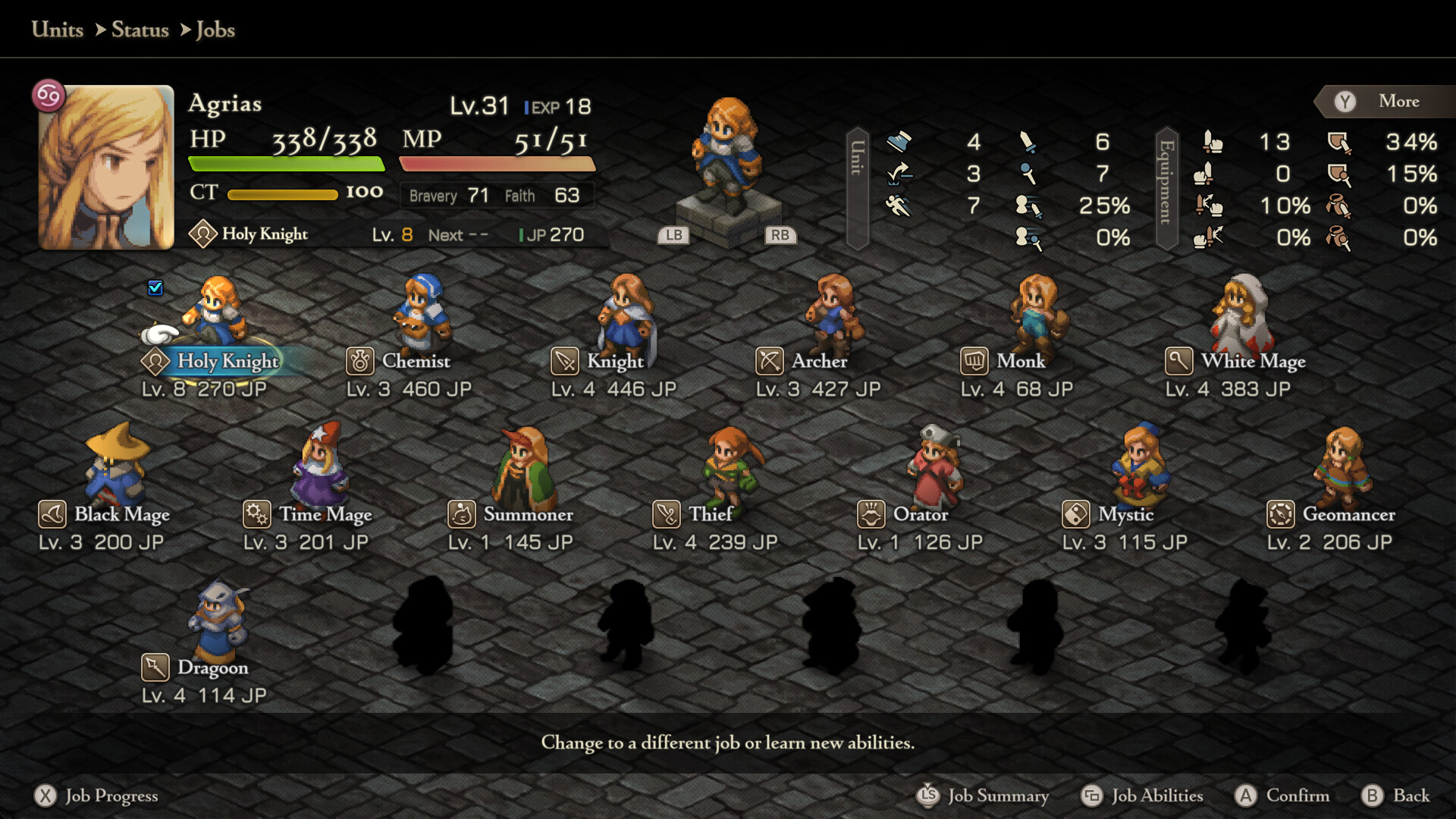
Character progression operates on two levels. There is the character level, which increases by performing any action in combat and determines base stats. Then there is the job level, which rises as you accumulate Job Points (JP). You earn JP for every successful action, regardless of the specific skill used—whether it’s an attack, a healing spell, or simply throwing a rock. All JP go toward the character’s current job class.
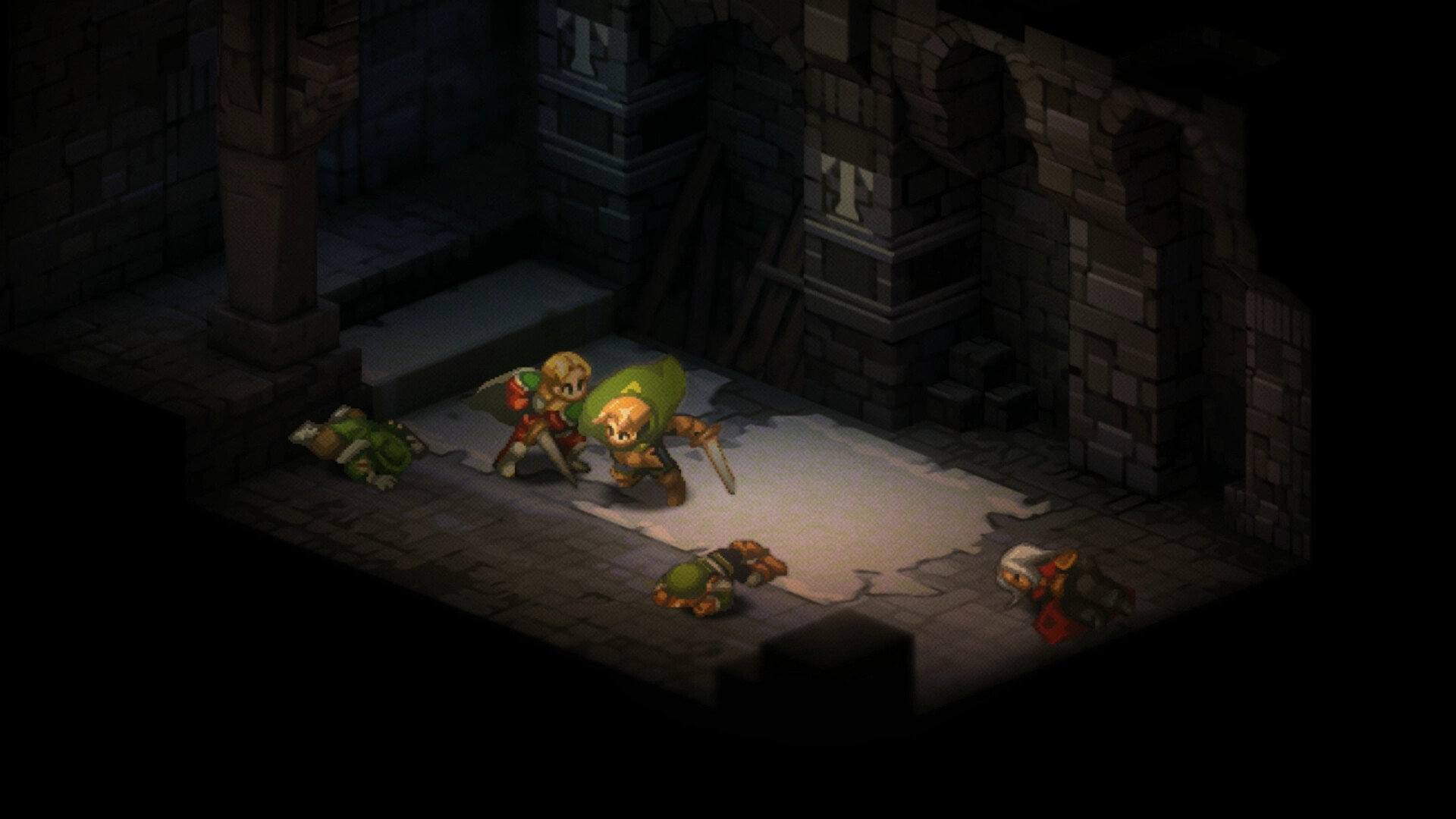
A key mechanic of the game is “JP Spillover.” When a unit earns JP, a small portion of those points is automatically distributed to allies sharing the same job. This means that if you keep a squad in a specific job, every fighter will gradually level it up, even if they aren’t actively using its skills themselves. For unique characters, their personal jobs count as “Squire” for the purposes of this spillover.
You can speed up the grind in a few ways. First, the Squire’s “JP Boost” passive ability increases JP gain by 50%. Second, you can finish off your own allies at the end of a battle when few enemies remain—it’s safe and yields a ton of JP. Third, you can leave a single weak enemy alive and simply spam support abilities, like the Squire’s “Focus”, which always succeed and cost no resources. You can use a Knight to shatter an enemy’s strength, speed, and gear, steal their money, XP, and JP, and perform dozens of other actions, all while racking up heaps of JP…
However, you shouldn’t over-level, as the game features enemy auto-scaling. If you grind all the way to level 99, you’ll encounter level 99 Red Chocobos in the starting area that will annihilate your entire party with Meteors. Trust me, you don’t want that.
The main ingredient in this mix is the job system. The game features over 20 jobs and 300 abilities in total. Each job has a unique set of skills that can be leveled up using JP. But things get really interesting when you start combining abilities from different jobs. Each character can equip:
- A primary job — determines base stats, available weapons and armor, and the core set of abilities.
- A secondary job — any other job, granting access to its skills during battle.
- A reaction ability — triggers automatically under specific conditions (parry, counterattack, etc.).
- A support ability — a passive bonus (e.g., JP Boost, Dual Wield, Poach).
- A movement ability — an ability affecting mobility (teleport, ignore height, flight).
It is precisely this system that gives the character-building such depth. Want a Monk who fights with both fists and ignores height differences? Level up the Ninja and Dragoon classes, equip their passive skills, and you’re all set. Want a mage who casts spells using mathematical formulas? Level up the Arithmetician—they’ll be able to blanket the entire map with the Holy spell without spending a single point of MP. And that’s just the beginning… By the end of the game, your heroes will be capable of smashing enemy faces (or gear) from halfway across the map, wiping out groups of enemies with a single spell, and much more.
Battles take place on schematic, rectangular maps. Each turn, a unit can move across several tiles and perform one action. Damage is influenced by elevation (attacking from higher ground grants a bonus), tile type (certain classes receive bonuses on specific terrain), attack direction (striking from behind deals more damage), and, of course, the zodiac sign.
Zodiac signs are a distinct mechanic that can safely be ignored during a first playthrough. Each character has a zodiac sign determined by their birth date. Sign compatibility grants bonuses or penalties to damage, healing, and the success rate of percentage-based abilities (such as Steal or Persuade). However, on normal difficulty, this has a negligible impact. If you want to “min-max,” choose Capricorn or Taurus for maximum damage.
Bravery and Faith are more critical stats. Faith increases the magic damage a character both deals and receives. Bravery affects the activation chance of reaction abilities (such as parrying or counterattacking) and the damage dealt by certain weapons, like katanas. If Bravery drops too low, the character will leave the party; if Faith becomes too high, they will leave to seek God. Just for fun: if Bravery is lowered during battle, the character might transform into a chicken.
Status effects become a headache in the late game. Enemies will turn your fighters into toads, put them to sleep, stop them in their tracks, and turn them to stone. Accessories that grant immunity to specific status ailments are your lifesaver. For instance, the Ribbon provides immunity to all status effects, and it can only be obtained via Poaching. Incidentally, in the remaster, the Ribbon can now be equipped by anyone—not just female characters—which is a welcome balance adjustment.
In Final Fantasy Tactics, equipment is tied to the character’s job. A Knight can wear heavy armor and shields, a Monk wears nothing at all, and a Mage is limited to robes and hats. Each piece of gear provides stat boosts, and some offer unique effects. Where can you find good gear? There are several ways to obtain it.
Poaching is a distinct mechanic. By unlocking the Thief’s “Poach” passive ability, you can land the finishing blow on monsters to obtain their carcasses. These carcasses can then be turned in at the Poacher’s Den in specific towns, where they are processed into unique items. Certain items such as the Ribbon (which grants immunity to all status ailments) or Genji Equipment (the best armor for a Samurai) can only be obtained through poaching. If you want to guarantee a rare drop, it is best to breed the monsters yourself using the Orator class and then defeat them in an easy battle.
A Thief can steal equipment directly during combat. The success rate depends on Zodiac signs and the Bravery stat, but some items—like the Genji Equipment worn by Marquis Elmdore—can only be acquired this way (though you may have to restart the battle repeatedly, as story bosses sometimes have an anti-theft passive ability; I personally had to restart over 50 times before Elmdore’s anti-theft passive switched to something else). Be warned, however: if an enemy steals your equipment, it is lost forever. Furthermore, enemy Knights can break your gear, just as you can break theirs. You need to fight Knights and Thieves quickly and ruthlessly. In the remaster, old tricks—such as stealing the Genji Set and Masamune from Elmdore—still work, which can actually make the game easier down the line.
Last but not least, each town has its own unique selection. You can view the full product catalog in the locations list. Rare items that aren’t sold anywhere else appear in the late game. It is important to know that there are three types of shops with different inventories—something the game never clearly explains. Some players have also complained that mechanics like accuracy, flanking bonuses, and height advantages aren’t explained either; you have to figure them out for yourself.
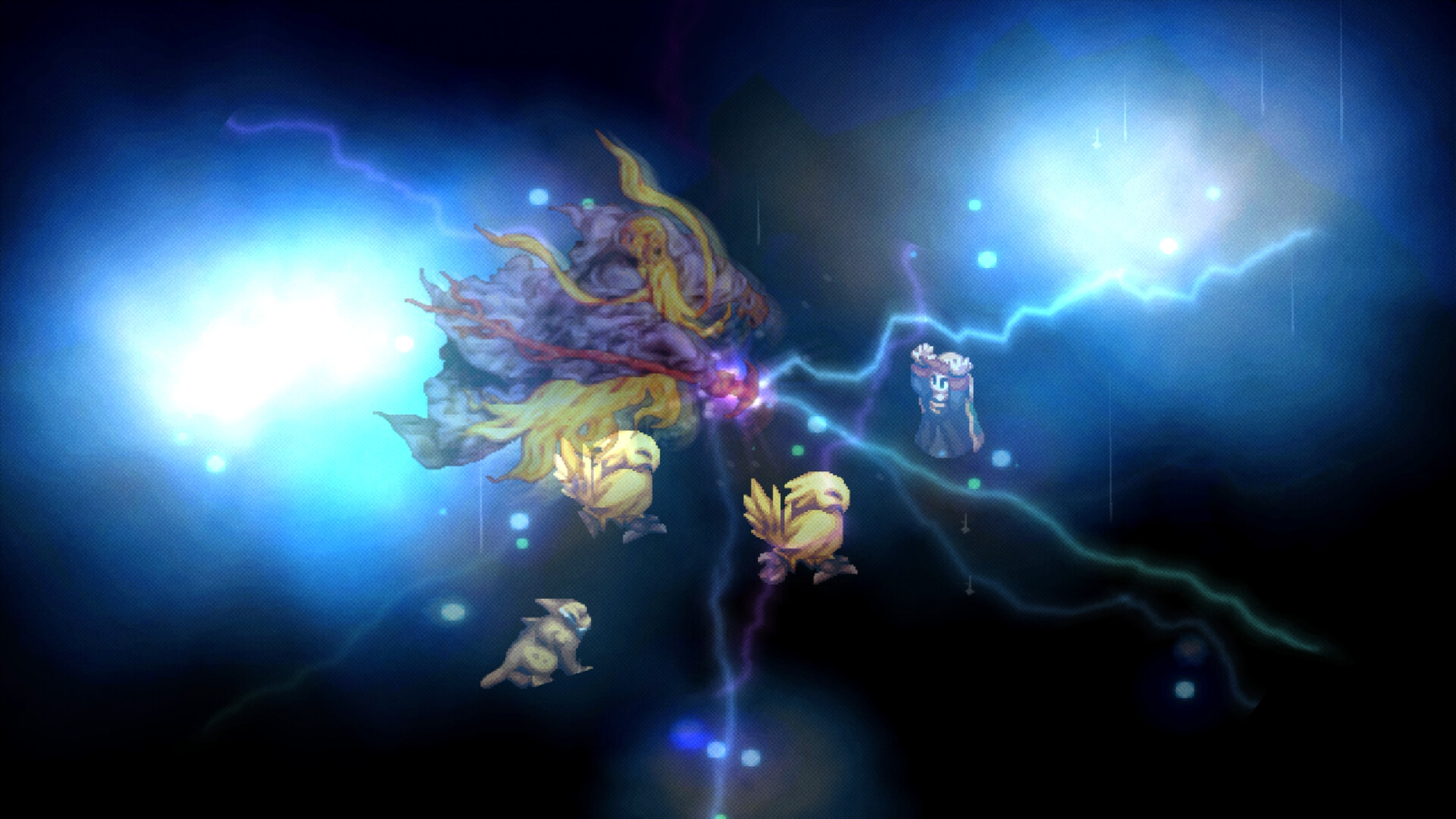
There are two abilities in the game that cannot be learned through standard means. The first is Ultima for Ramza, and the second is Zodiac for any Summoner in your party.
Ultima can be learned from two types of enemies: Assassins (Celia and Lede) or Ultima Demons. Ramza must be in the Squire job class, be targeted by the spell, and survive the hit. Assassins offer the easiest route: equip a Black Costume to guard against Shadow Stitch and an Angel Ring to prevent the Stop status; they will likely cast Ultima under these conditions. The best locations for this are the roof of Riovanes Castle or the gates of Limberry Castle. Demons are trickier—they rarely cast Ultima because they have other, more useful spells at their disposal.
Zodiac can only be learned during the final battle of the Deep Dungeon, where Elidibus casts the spell. It deals around 800 points of damage, so your Summoner is unlikely to survive the hit. To learn it, significantly lower your Summoner’s Faith using the Mediator’s “Solution” ability (by about 30–40 points) or the Knight’s “Mind Break.” And, of course, use Shell and Wall.
There are also four secret characters in the game: Reis, Beowulf, Worker 8, and Cloud. The first three join during a single long questline, whereas Cloud requires a specific, individual approach.
Additionally, the game features Orlandeau—the legendary “Thunder God”—who can be recruited in the late game. He was absurdly overpowered in the original version; while he was slightly nerfed in the remaster, he remains one of the strongest fighters in the game. The Sword Saint class grants access to incredibly powerful swords and spells, including Lightning Stab, which deals massive area-of-effect damage. The Monk-Ninja (Dual Wield) combo still makes things easier, especially in the early and mid-game. And Cid and Cloud remain absolute powerhouses—especially once you unlock Finishing Touch and watch them deliver instant kills or petrify enemies.
The Arithmetician remains broken. It’s best to level this class up by sending the character on errands, as leveling it in actual combat is far more troublesome due to the class’s speed stats. The Samurai is another great asset, particularly if you manage to steal the Genji Set. The Summoner is a valuable ally, especially in the late game; if you combine it with Manafont and Lich, you’ll see just how effective it is during the finale. Even the Machinist can turn the tide by sacrificing their own HP to unleash a lethal artillery barrage.
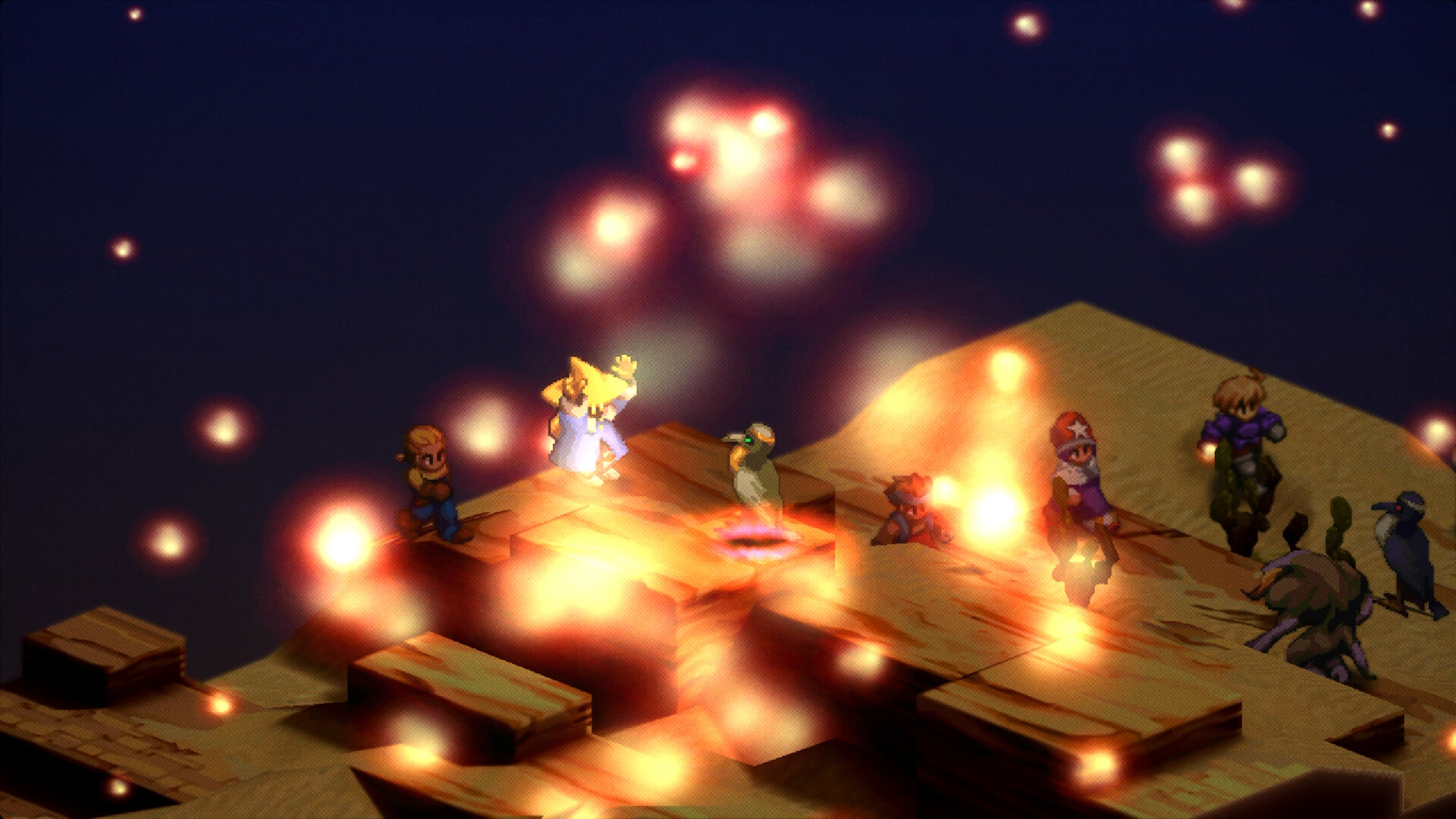
The Ivalice Chronicles bundles both the original game and the remaster in a single package. You can choose which version to play from the main menu, though save files are not cross-compatible. The original version features the English translation from War of the Lions, characterized by a lofty, archaic style—which was a bit of a challenge for me to follow given my language proficiency.
The remaster adds English and Japanese voice acting. The English dub is solid: the voices are lively, suit the characters well, and evoke the feel of a theatrical production based on a classic play. It also includes autosaves, a battle speed-up function, and an overhead view of the battlefield. There is a strange visual filter applied to the image that cannot be disabled, though it isn’t particularly annoying.
An important note: if you play the classic mode (the original PS1 version), you cannot transfer your save data to the enhanced version. They are two separate applications, and switching between them requires a full restart of the game.
On the downside, the remaster omits some content found in War of the Lions—specifically, the appearances of Balthier from Final Fantasy XII and Luso from Tactics Advance 2, as well as a couple of extra classes: the Dark Knight and the Onion Knight. I have no idea why Square Enix decided to cut this; presumably, they wanted the remaster to stay closer to the original release, though they could have simply created an “ultimate” version containing all the content. As it turns out, datamining reveals that this content is still present in the game files. Modders have already confirmed that Balthier, Luso, the Dark Knight, the Onion Knight, and even the multiplayer missions from the PSP version are in the game—they’ve simply been disabled. This suggests either plans for future DLC or a reliance on the modding community to unlock them. Square Enix officially stated that they would not include the WotL content, but the fact remains: the content is in the game, it’s just inaccessible. That is, to put it mildly, a shame.
Patch 1.5.0 (released in June 2026) added New Game+ and a Zodiac Compatibility feature that displays sign compatibility within the UI. That’s a good thing, but it still didn’t restore the cut content.
The game uses Denuvo Anti-Tamper, which necessitates constant online verification. One user complained about being unable to play on the Steam Deck in offline mode while traveling because the game demanded an internet connection. For a portable game, that’s a huge downside. Plus, Denuvo negatively impacts performance; the game can stutter even on older systems. Modding is also restricted due to Denuvo, so the community won’t be able to easily extract the cut content.
Audio is another issue. Some users have noted that the sound mastering is flawed: the bass has been boosted, making the music sound worse than in the original. This is particularly noticeable on tracks like The Zodiac Brave Story and Trisection. It’s a pity, as the soundtrack is one of the game’s highlights.
The interface is a mixed bag. On one hand, it’s more user-friendly: there’s now a turn order list, damage prediction, and the ability to undo movement or switch to a different character. On the other hand, some veterans complain that menu navigation has become clunkier—it takes more clicks to check learned skills, see how much JP a character has in a specific class, or learn and equip skills. The camera is also positioned too low; the focus is always in the center of the screen, but the new interface occupies the lower section, which impairs visibility.
The speed-up button has a lag: it takes a full second to activate and another second to deactivate. This can lead to accidentally skipping lines of dialogue.
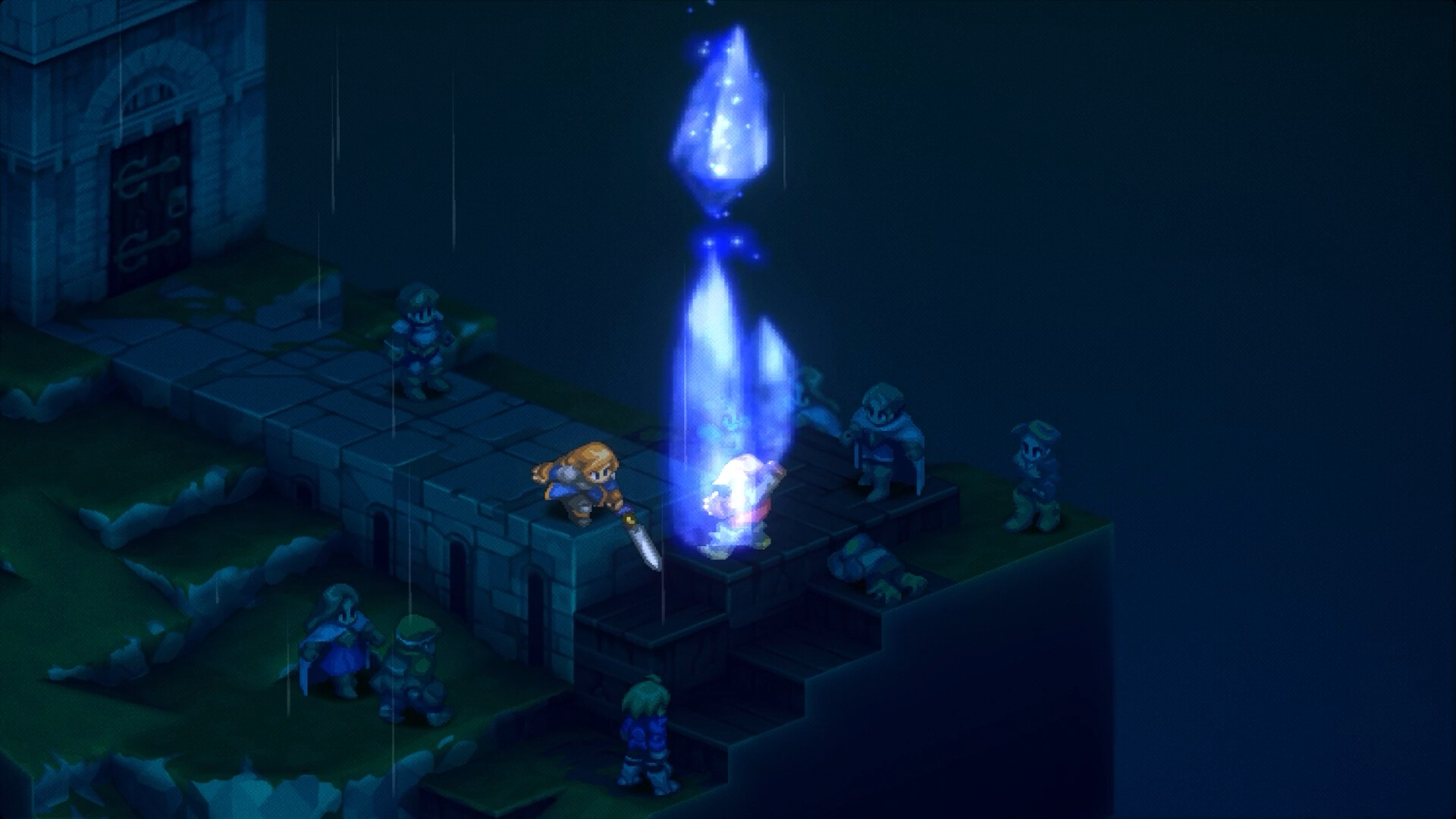
Final Fantasy Tactics offers an enjoyable and engaging experience. I wouldn’t say I’m suddenly ready to play every tactical RPG out there; the gameplay itself didn’t deliver any “wow” moments—it’s actually quite monotonous and repetitive. However, the story was genuinely compelling. The characters are great, and the remaster’s voice acting is solid. This isn’t just “another tactical RPG”; it’s a tale of war, betrayal, class struggle, and the price people are willing to pay trying to remain human in a world where everyone uses one another.
The job system is arguably the best part of the gameplay. JP Spillover, class combinations, secret characters with unique jobs, poaching, and stealing—all of this creates a deep, fascinating sandbox for experimentation. Meanwhile, the Deep Dungeon and secret abilities like Ultima and Zodiac add replayability and a real challenge for those looking to get the most out of the game. Even when combat feels repetitive, the character building is addictive. You’re constantly thinking, “What if I try a Monk with Dual Wield and Teleport? What if I make an Arithmetician with Holy and just wipe enemies off the map?”—and that’s what hooks you.
The remaster received high praise from critics, with sales topping one million copies in three months—and deservedly so. Yes, the remaster is lazy; yes, content was cut; yes, the filter can’t be turned off; yes, there’s Denuvo; yes, the audio is botched. But it remains the best way for a new generation to experience this classic. If you’ve never played Final Fantasy Tactics, pick it up. If you’re a veteran, wait for a sale or play the PSP version. If you want the perfect experience, set up an emulator, download some mods, and enjoy. Either way, Final Fantasy Tactics is worth your time.
Game score: 8/10. I’m deducting a point for the tedious opening, uneven difficulty, and the content cut from the remaster. However, the story, characters, job system, and secret characters make it worth enduring those flaws.
Remaster score: 7/10. A solid effort, but they could have done more. Cutting content from War of the Lions is a slap in the face to fans. Still, for newcomers, it’s a great chance to experience a classic. If the price were lower, the filter toggleable, Denuvo removed, and the audio fixed, it would be perfect. $30 is a fair price; $20 would be excellent.
If you love Final Fantasy for its storytelling and are willing to put up with some tedious gameplay for the sake of the narrative, get it. If you aren’t familiar with the tactical RPG genre, be prepared for the fact that the game won’t hold your hand. Read guides and don’t hesitate to lower the difficulty, it will help you understand how the game works. Besides, getting 100% completion requires at least two playthroughs anyway, as there are things you’re bound to miss.


